
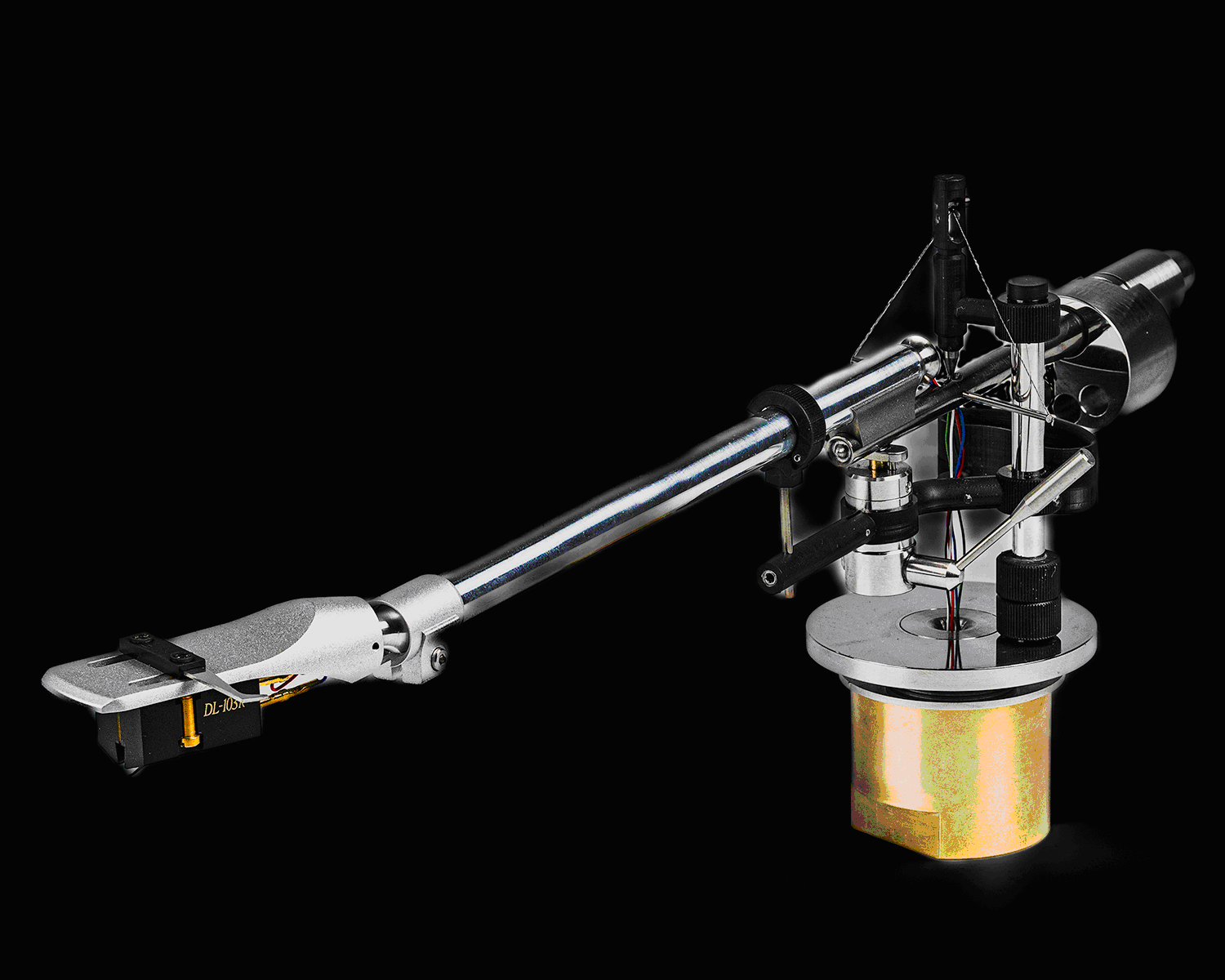
UA-101 with Stabilizer, photo Paul Elliott
The pre-production prototype of the UA-101 tonearm marked the moment the project crossed a critical threshold − from proving that the design could work to demonstrating that it was ready to meet the world. No more 3D printed parts. All components were now in their final final form and in the intended production materials with correct tolerances and clearances.
The transformation of going from working prototype to pre-production prototype was not just cosmetic. Every lesson extracted from the first working prototype and its subsequent performance testing had been designed into this revision. Minor issues identified in earlier resin-printed sections had been addressed through material selection and refined geometry in the machined replacements. Assembly issues that had surfaced during the proof-of-concept build were resolved with design updates. Dimensional data gathered across multiple cartridge installations and azimuth calibration cycles informed tightened tolerances on bearing housings, pivot interfaces, and alignment geometry.
The results were obvious. Every measurable parameter either met or exceeded the benchmarks established during earlier testing. More telling than the numbers, however, was the listening. Tracks that had served as diagnostic tools during performance testing − the opening recorder passage of Stairway to Heaven, the spatial complexity of Joni Mitchell's Don Juan's Reckless Daughter, the transient detail buried in Steely Dan's Aja − now revealed themselves with an ease and authority the earlier prototype had only hinted at. Center image focus sharpened. Soundstage depth gained a new sense of proportion. High-frequency air opened without grain or fatigue. The convergence between measured and perceived performance that the testing protocol had been designed to achieve was not just present − it was sort of effortless.
The pre-production prototype exceeded expectations not as a rough proof of concept outperforming its station, but as a near-finished product performing at the level the market would judge it by. It demonstrated that the UA-101 was ready for introduction − not as a promise, but as a refined, substantive instrument.
Still, the process was not quite finished. Fine-tuning remained: subtle refinements to surface treatments, final decisions on packaging and documentation details, and the last quality-control protocols that separate a superb pre-production unit from a fully production-ready product. The UA-101 had proven itself. The final stage − preparing it for consistent, repeatable production − was now clearly within reach.