
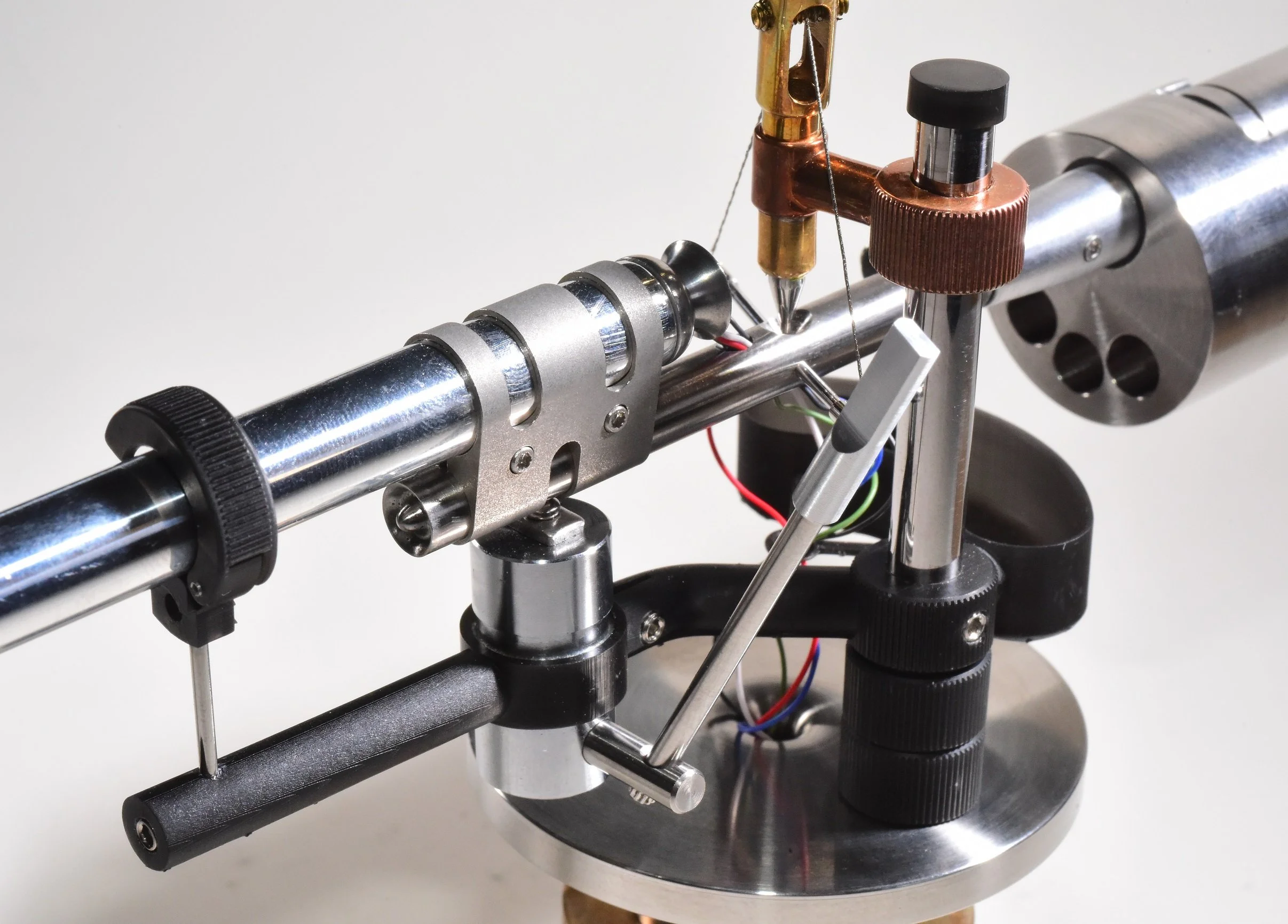
UA-101 tonearm early prototype
The first working prototype of the UA-101 tonearm represented a significant milestone in the project's development − a moment where theories, engineering, and digital models finally came together into a physical, functioning moment of truth.
Built from a deliberate combination of CNC-machined pre-production parts, high-resolution resin-printed 3D components, and lost-wax cast metal elements, this prototype was never intended to be a finished product. It was a proof of concept, assembled to answer one fundamental question: does this design actually sound good?
The answer exceeded my expectations.
Each manufacturing method used in the first prototype served a distinct purpose. CNC-machined components provided the dimensional precision necessary for critical bearing surfaces, pivot mechanism, and geometries where tolerances needed to be exact. These parts established the mechanical foundation of the tonearm, ensuring that the critical geometries behaved exactly as required. Where form and mass distribution mattered but surface finish and final material selection were still under development, high-resolution resin-printed parts filled the gap. 3D printing allowed complex shapes and structures to be built quickly and inexpensively, making it possible to evaluate fit/finish, visual proportions, and assembly sequences without committing to machined parts. For elements requiring specific density, damping characteristics, or structural rigidity that plastic could not replicate, lost-wax cast metal parts completed the assembly. These castings captured the intended mass properties of the design and provided the structural requirements necessary for meaningful performance testing.
The result was a hybrid of polished stainless steel, tungsten, and titanium, black resin, and copper and brass castings. Although it lacked the refinement of a production unit, the first UA-101 prototype delivered tracking performance, resonance control, and dynamic behavior that went well beyond what a rough proof-of-concept build would typically produce. The bearing system exhibited the near-frictionless and mechanical performance the design predicted. The effective mass fell within the target range. Anti-skate compensation responded linearly. Cueing was smooth and controlled. Most importantly, the tonearm's fundamental geometry and alignment parameters (that John Gordon assisted with) − the relationship between its pivot point, headshell offset, overhang, and tracking angle − confirmed that the underlying engineering was viable and genuinely promising.
This stage of development was never about polished aesthetics or market readiness. It was about design and performance validation. The first prototype confirmed the design assumptions and, equally valuable, revealed where refinements were needed. Assembly sequence challenges identified opportunities to simplify production fixtures. Dimensional data gathered from the CNC and cast parts informed updated tolerances for the next revision.
The first working prototype of the UA-101 accomplished exactly what it was supposed to do. By proving the concept with tested mechanical performance, it provided the confidence and the engineering data necessary to advance to the next critical phase: the pre-production prototype, where material selections would be finalized, fit and finish elevated, and the tonearm prepared for its transition from a bench-test proof of concept to a refined, production-ready tonearm.